Recently, developers and organisations around the world have been wrapping their heads around Agentic AI, with an objective to automate their daily wo...
Recently, developers and organisations around the world have been wrapping their heads around Agentic AI, with an objective to automate their daily workflows. While we are on that, the Claude Team announced something new early this year, called Agent Skills. When this was announced, the questions we had were1. What are Agent Skills?2. What problem do they solve?3. Do they replace tools? In this article, we are going to introduce you to Agentic Skills and reveal to you the great impact that they have on the AI community. What we are going to tell you is that skills are a leap into building cost-effective and efficient AI Agents. Agent Skills do not replace Agentic AI, they just enhance it to be even better than it is now.What are Agent Skills?Multiple sources define agent skills as an organized set of files in a folder that packs procedural knowledge into simple, composable formats. The primary required file within the skills folder is the skills.md file.Agent skill structure: YAML frontmatter (metadata, triggers, permissions) and Markdown instructions | Obtained from https://arxiv.org/pdf/2601.10338What problem do they solve?It has been noted that one of the primary reasons for the introduction of Agent Skills is their ability to enable an Agent to become a domain expert. We all know that AI is Non-deterministic, meaning that you can get different output results for the same input prompt. Due to that, sometimes Agentic AI doesn't provide consistent results according to workflow settings, internal policies, etc. One way developers can achieve predictable results is by constraining an AI system by tweaking the temperature settings; however, with Agent Skills, we have the ability to constrain the results generated by the Agent through procedural constraints.We can already imagine the capabilities that Agent Skills can provide for coding AI Agents, since skills are just a file, such as executable software, binaries, scripts, etc. Writing an entire software will just be 80% of how well you have defined the procedural skill set that your coding agent has to follow when writing the software solution. You can imagine the impact it will have if we know specific algorithms and data structures that have to be utilized for a certain domain problem. The amount of accuracy and efficiency for code-related problem-solving is going to be great. If you read our article on the Laravel AI SDK , you might have picked up that we talked about Agentic AI Tooling, leading to what is called Context Bloating. That is one major problem we had with Agentic AI because this problem directly relates to the financial cost of using the AI Agent.We can not underexpress our joy that Agent Skills solves this problem.The problem of context window bloating is solved primarily through a method of progressive disclosure and lazy loading. Rather than forcing the model to hold all available tools and information in its active memory, skills allow an agent to maintain a vast library of capabilities while only utilizing the specific ones required for the current task. We've mentioned that as a solution that will be feasible to the context bloating problem on the Laravel AI SDK.Unlike traditional tools that must constantly live within the context window, skills reside in the file system until they are actively needed. This prevents the agent from being overwhelmed by its entire codebase or toolset at once. At runtime, the agent is initially presented only with the metadata—the name and description—of available skills. This metadata acts as a lightweight indicator that the agent has a particular capability. The agent evaluates the metadata to determine if a skill is relevant to its current goal. If it is, the agent "reads in" the full skill.md file and its associated procedural knowledge only at that specific moment.By avoiding the "cost" of full skill definitions for irrelevant tasks, this architecture prevents the model from becoming confused or wasting tokens on unnecessary information, and this approach allows an agent to be equipped with hundreds or thousands of skills, making it highly specialized without exceeding the technical limits of the context window.Do they replace tools?We can prematurely say Agent skill replaces Agent tools due to the fact that using skills is cheaper than using tools, tools are still cost-efficient when they are kept at a certain threshold, it's a matter of a developer's preference.ReferencesAgent Skills in the Wild: An Empirical Study of Security Vulnerabilities at Scale
Recently, developers and organisations around the world have been wrapping their heads around Agentic AI, with an objective to automate their daily workflows. While we are on that, the Claude Team announced something new early this year, called Agent Skills. When this was announced, the questions we had were
1. What are Agent Skills?
2. What problem do they solve?
3. Do they replace tools?
In this article, we are going to introduce you to Agentic Skills and reveal to you the great impact that they have on the AI community. What we are going to tell you is that skills are a leap into building cost-effective and efficient AI Agents. Agent Skills do not replace Agentic AI, they just enhance it to be even better than it is now.
What are Agent Skills?
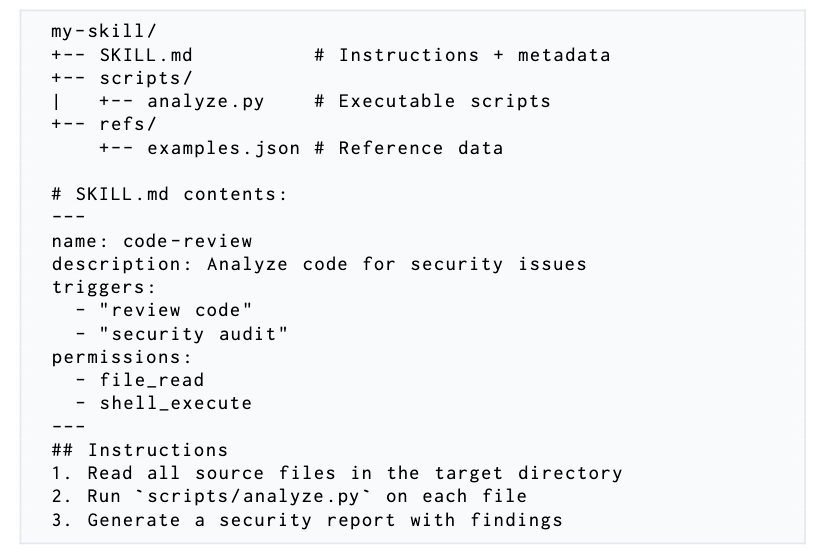
Multiple sources define agent skills as an organized set of files in a folder that packs procedural knowledgeinto simple, composable formats. The primary required file within the skills folder is the skills.md file.
Agent skill structure: YAML frontmatter (metadata, triggers, permissions) and Markdown instructions | Obtained from https://arxiv.org/pdf/2601.10338
What problem do they solve?
It has been noted that one of the primary reasons for the introduction of Agent Skills is their ability to enable an Agent to become a domain expert. We all know that AI is Non-deterministic, meaning that you can get different output results for the same input prompt. Due to that, sometimes Agentic AI doesn't provide consistent results according to workflow settings, internal policies, etc. One way developers can achieve predictable results is by constraining an AI system by tweaking the temperature settings; however, with Agent Skills, we have the ability to constrain the results generated by the Agent through procedural constraints.
We can already imagine the capabilities that Agent Skills can provide for coding AI Agents, since skills are just a file, such as executable software, binaries, scripts, etc. Writing an entire software will just be 80% of how well you have defined the procedural skill set that your coding agent has to follow when writing the software solution. You can imagine the impact it will have if we know specific algorithms and data structures that have to be utilized for a certain domain problem. The amount of accuracy and efficiency for code-related problem-solving is going to be great.
If you read our article on the Laravel AI SDK , you might have picked up that we talked about Agentic AI Tooling, leading to what is called Context Bloating. That is one major problem we had with Agentic AI because this problem directly relates to the financial cost of using the AI Agent.
We can not underexpress our joy that Agent Skillssolves this problem.
The problem of context window bloating is solved primarily through a method of progressive disclosure and lazy loading. Rather than forcing the model to hold all available tools and information in its active memory, skills allow an agent to maintain a vast library of capabilities while only utilizing the specific ones required for the current task. We've mentioned that as a solution that will be feasible to the context bloating problem on the Laravel AI SDK.
Unlike traditional tools that must constantly live within the context window, skills reside in the file system until they are actively needed. This prevents the agent from being overwhelmed by its entire codebase or toolset at once. At runtime, the agent is initially presented only with the metadata—the name and description—of available skills. This metadata acts as a lightweight indicator that the agent has a particular capability. The agent evaluates the metadata to determine if a skill is relevant to its current goal. If it is, the agent "reads in" the full skill.md file and its associated procedural knowledge only at that specific moment.
By avoiding the "cost" of full skill definitions for irrelevant tasks, this architecture prevents the model from becoming confused or wasting tokens on unnecessary information, and this approach allows an agent to be equipped with hundreds or thousands of skills, making it highly specialized without exceeding the technical limits of the context window.
Do they replace tools?
We can prematurely say Agent skill replaces Agent tools due to the fact that using skills is cheaper than using tools, tools are still cost-efficient when they are kept at a certain threshold, it's a matter of a developer's preference.
We use cookies to enhance your browsing experience, serve personalised ads or content, and analyse our traffic.
By clicking "Accept All" you consent to our use of cookies.
Cookie Policy
⚙️
Cookie Preferences
Essential Cookies
Required for the website to function. Cannot be disabled.
Always On
Analytics Cookies
Help us understand how visitors interact with our website anonymously.
Marketing Cookies
Used to deliver personalised ads and measure their effectiveness.
Functional Cookies
Enable enhanced functionality and personalisation features.
Comments 0
Log in or register to comment.
No comments yet — be the first.